


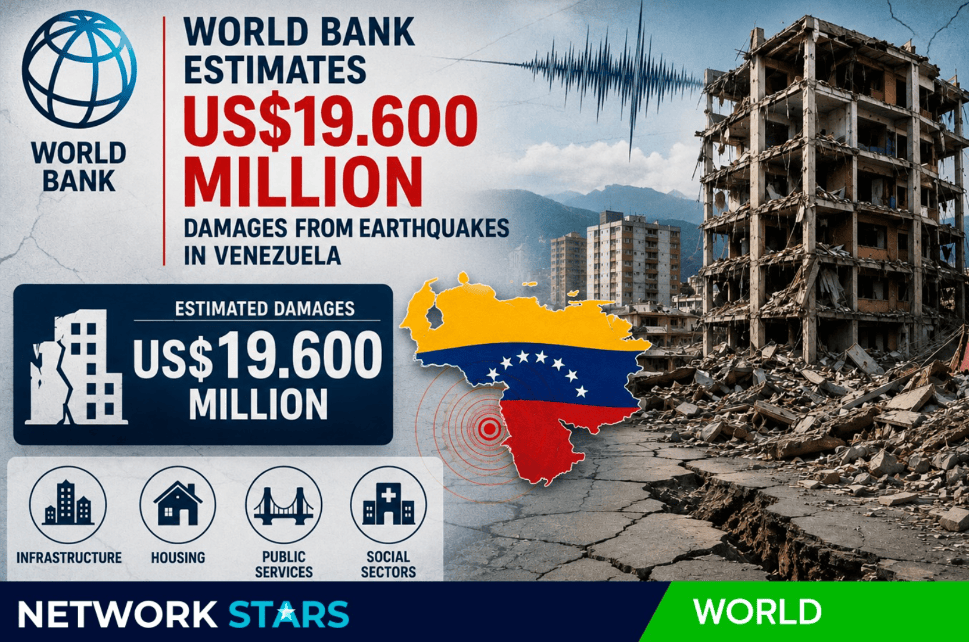
The two devastating earthquakes that struck the central-northern region of the country have generated a strong economic and social impact. According to a preliminary assessment presented by the World Bank, the preliminary figure for earthquake damage in Venezuela reaches $19.6 billion in infrastructure and buildings, which is equivalent to approximately 18% of the national Gross Domestic Product (GDP).
Impact on housing, health, and education
The international organization’s report indicates that almost half of the total costs correspond to damages in residential sectors. The state of La Guaira and the Capital District, where central Caracas is located, concentrate nearly 50% of the material losses. Likewise, the natural disaster on June 24 left almost 5,400 people dead and more than 16,700 injured following the collapse of multiple structures and the disruption of basic services such as water and electricity.
In the social sphere, educational and health infrastructure suffered severe consequences: more than 900 schools across nine states and 38 hospitals registered structural damage. Conversely, energy sector facilities experienced a minor impact compared to the real estate and public utility sectors.
The challenge of international financing and reconstruction
Susana Cordeiro Guerra, World Bank Vice President for Latin America and the Caribbean, emphasized the urgency of publishing this preliminary analysis to expedite government financing decisions and coordinate international aid. However, United Nations projections place total reconstruction costs at a higher figure, estimated at $37 billion.
The speed of economic recovery will depend on access to external financial resources. Venezuela has remained disconnected from multilateral lenders and in default since 2017. To overcome these barriers, the World Bank is working jointly with the Inter-American Development Bank (IDB) and CAF to coordinate technical assistance and encourage private investment in the reconstruction process.
