


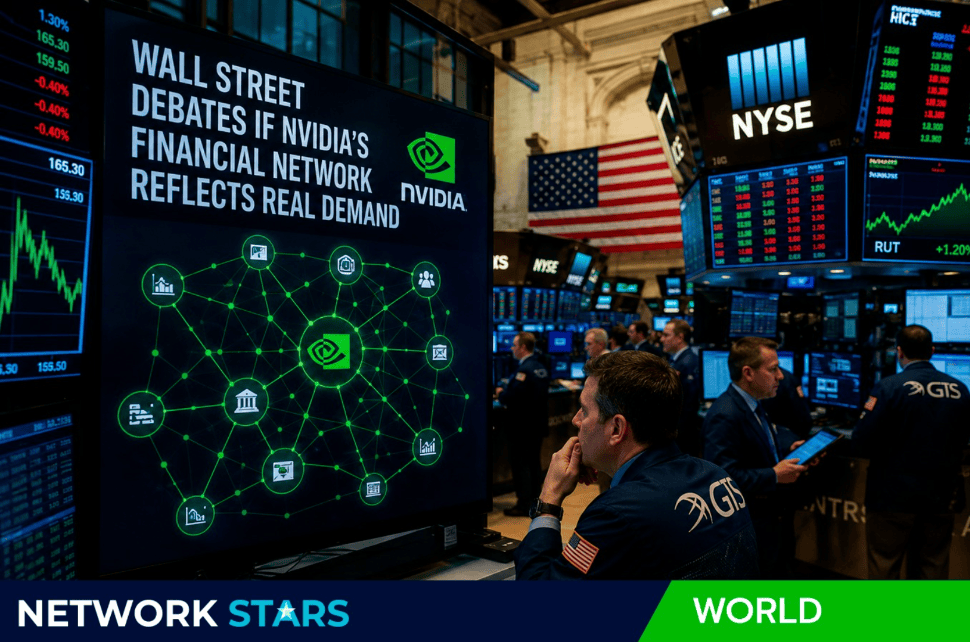
The artificial intelligence ecosystem is facing a crucial debate on Wall Street. Analysts and investors question whether the intricate financial network and Nvidia circular financing reflect genuine, organic market demand or if they are inflating a speculative bubble.
What Does Nvidia Circular Financing Involve?
Nvidia circular financing occurs when a technology supplier helps fund its own customers so they can purchase its products or services. Nvidia occupies a central position in this model by manufacturing key semiconductors, investing capital in artificial intelligence startups, and providing credit support to firms that subsequently buy its processors.
While this mechanism efficiently resolves initial liquidity bottlenecks, it raises doubts about how much spending relies on independent end users and how much requires continuous capital injections.
The Critics: Risk of an AI Financial Bubble?
Influential figures in the financial sector have raised alarms regarding this commercial scheme:
- Michael Burry: Shared graphical analysis showing how Nvidia sits at the center of multiple investment, service, and hardware deals, suggesting high interdependence across the industry.
- Steve Hanke: Has been firm in calling the current dynamic an AI bubble, warning that conflating loans, guarantees, and equity investments hides true financial risks.
The Defense of the Model: Coordinating Capital and Capacity
On the other hand, several experts defend the semiconductor company’s strategy:
- Denny Fish (Janus Henderson): Argues that these operations align incentives between manufacturers and data centers to expand computing capacity and generate legitimate external demand.
- Dario Amodei (Anthropic): Explained that the model serves an economic rationale where suppliers provide commercial capital to accelerate the technological development of companies with promising future revenues.
- James E. Thorne: Points out that Nvidia circular financing must be evaluated with nuance, distinguishing the real scarcity of infrastructure from the price at which stocks trade.
The 5 Key Factors to Assess Real Risk
To determine the financial strength of Nvidia’s ecosystem, analysts recommend monitoring five fundamental variables:
- External Demand: Revenue growth from users and companies outside the financing circuit.
- Effective Utilization: Real usage of data centers and renewal of contracted capacity.
- Cash Conversion: Actual cash flow generated compared to future commitments and guarantees.
- Customer Concentration: Level of reliance on a small group of tech giants.
- Refinancing and Obsolescence: Ability to roll over debt as AI processors continue to evolve
Source: Yahoo Finanzas
