


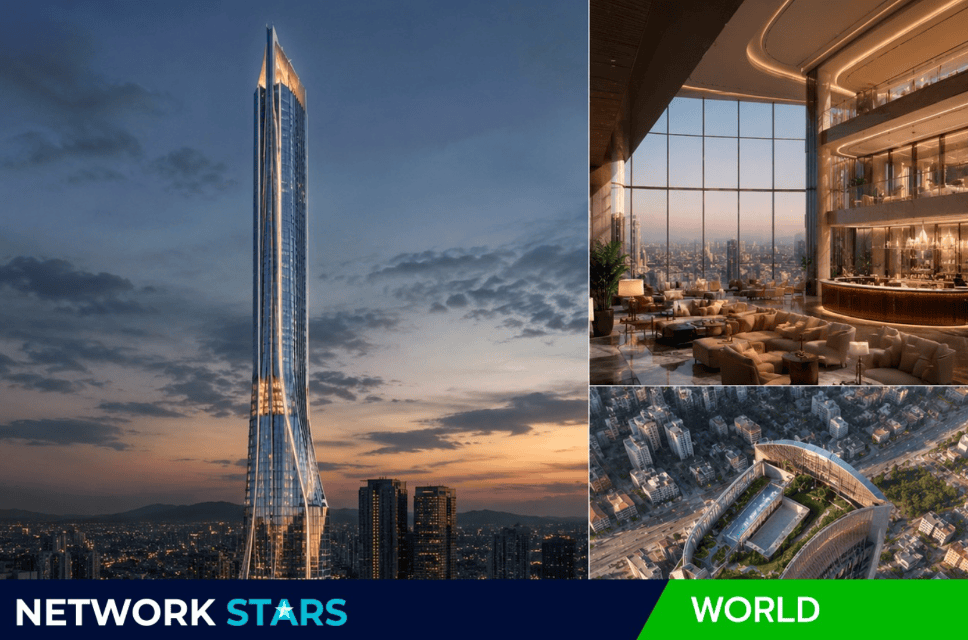
Latin America is stepping up its presence on the global architectural map. Far from the towering skyscrapers of the United Arab Emirates, the United States, or China, the region is proving its capacity to deliver advanced mega-engineering projects. The pinnacle of this ambition is the Rise Tower, a project launched in Mexico in 2023 that will become the tallest structure in all of Latin America.
Where and When the Rise Tower Is Being Built?
Since the turn of the millennium, the city of Monterrey has established itself as an urban laboratory for large-scale construction. In this metropolis, several architectural firms have executed landmark projects such as the Obispado Towers, which opened in 2020 and have held the title of the state’s tallest buildings to date.
Located in the exclusive Obispado neighborhood—a central hub of Monterrey—the Rise Tower will provide breathtaking panoramic views of both the cityscape and the surrounding mountain ranges. Construction is being led by Nest and Ancore Group, featuring an architectural design created by Ancore’s team alongside Mexican architect Esteban Ramos.
Features of the Rise Tower: A Record-Breaking Skyscraper
Standing at a total height of 484 meters, the Rise Tower will surpass the Gran Torre Santiago in Chile, which held the regional record for the past decade. The project is designed as a “vertical city,” integrating residential apartments, a luxury hotel, corporate offices, and retail spaces.
Key Construction Facts:
- Total Height: 484 meters (408 meters of habitable space topped by a 76-meter architectural spire).
- Global Ranking: It will rank as the 13th tallest skyscraper in the world.
- Internal Distribution: 35 levels allocated for corporate offices, 22 levels for residential apartments, and 10 levels dedicated to a luxury hotel.
- Amenities: 4,300 square meters of green areas and 8,000 square meters dedicated to leisure spaces.
- Completion Date: Grand opening is expected between late 2026 and early 2027.
By June of this year, the tower surpassed 345 meters in height, with a large portion of its exterior already clad in glass. Although initial plans featured a metallic industrial facade honoring Mexico City’s iconic 1956 Latinoamericana Tower, the design evolved toward a modern glass exterior matching the aesthetic of major developments in Asia, Europe, and the United States.
Structural Design and Seismic Engineering
The architecture of the Rise Tower features a rectilinear form backed by a reinforced core and a perimeter framing system built to withstand lateral loads, a critical requirement given the region’s seismic activity. Furthermore, its aluminum and glass envelope optimizes thermal regulation and helps manage high-altitude wind pressure
Source: Yahoo Noticias
