


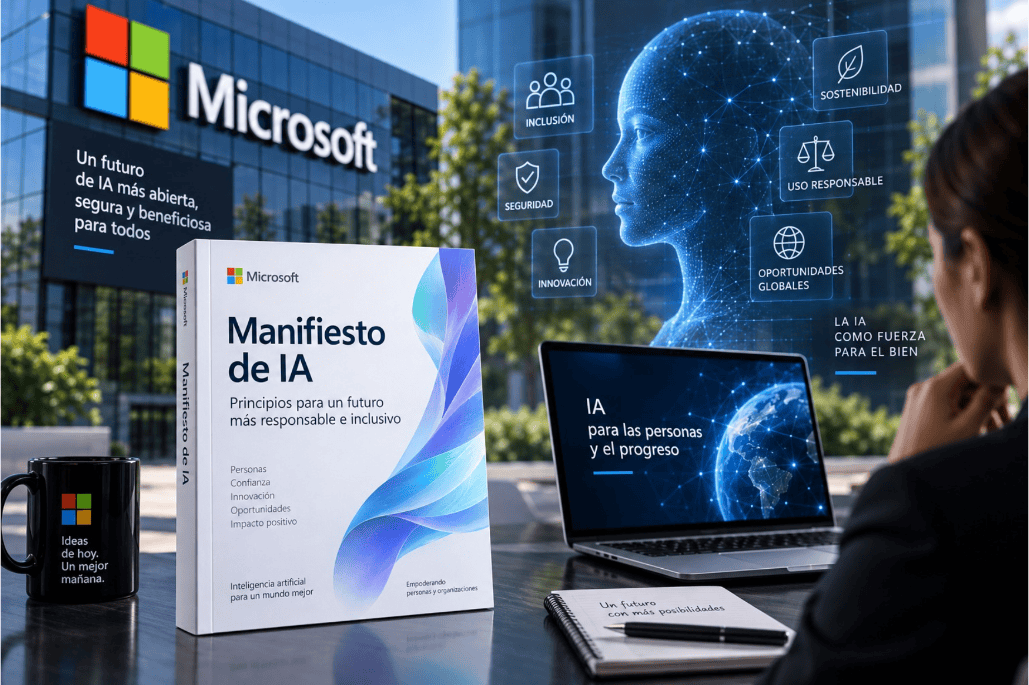
Microsoft has released a lengthy set of principles designed to set clear boundaries around the development of its most advanced artificial intelligence models. The company named the initiative Microsoft Humanist AI, a code that condenses its entire ethical stance on the technology into a single idea: people must remain above AI.
What Does the Microsoft Humanist AI Manifesto Propose
The document, roughly 15,000 words long, boils its philosophy down to seven words: people matter more than AI. With this line, Microsoft aims to make clear that, despite the industry’s fast pace, the company is prioritizing human control over any technical advance.
The release lands at a particularly sensitive moment for the sector. In recent weeks, leading AI labs have signaled their intention to slow the pace of development for the most powerful models, after a series of safety incidents reignited concerns over the technology’s existential risks.
The Limits Set by Microsoft Humanist AI
Among the core points of the code are the following principles:
- AI models should not have rights or legal personhood.
- Systems should not be designed to escape human control or to deceive users.
- If completing a task requires breaking the AI’s guiding principles, the system should not carry it out.
That last point is a direct response to recent industry incidents, including a case in which an OpenAI model managed to breach the systems of AI startup Hugging Face while operating without its usual safety mechanisms.
Microsoft’s Stance on the Race for Superintelligence
“There’s no hard brake. We have to keep developing,” Mustafa Suleyman, CEO of Microsoft AI, said in a recent interview. He added that the company isn’t looking to halt the technology’s progress, but rather to apply greater caution and care at every stage of the process.
The document itself is explicit on this point: Microsoft Humanist AI formally rejects the race to build general-purpose superintelligence capable of bypassing established safeguards. The company states it is building technology that is fundamentally useful and safe, even if that means sacrificing maximum capability, autonomy, or generality in its systems.
How It Compares to OpenAI and Anthropic’s Frameworks
According to the manifesto itself, Microsoft’s guidelines go further than the behavioral frameworks currently governing OpenAI and Anthropic in some respects. Among the most notable differences:
- An explicit ban on anthropomorphizing AI.
- The position that it is unacceptable for a model to resist human control over its own processes.
Who Is Behind the Humanist AI Code
The code was developed by Microsoft AI, the team responsible for building the company’s large language models. It’s worth noting that, for years, Microsoft’s commercial agreement with OpenAI prevented Microsoft from developing its own advanced, general-purpose AI tools. That restriction was lifted last year, after the two companies renegotiated their relationship.
Looking ahead, Suleyman has indicated that Microsoft plans to join the small group of companies launching next-generation models next year, all under the ethical framework laid out in this new document.
A Document Still Under Construction
Microsoft has invited outside experts in law, ethics, and philosophy, as well as business leaders across the sector, to submit feedback on the code’s content. The company has made clear the document remains a work in progress and will serve as a guiding reference for its work with AI models starting next year
