


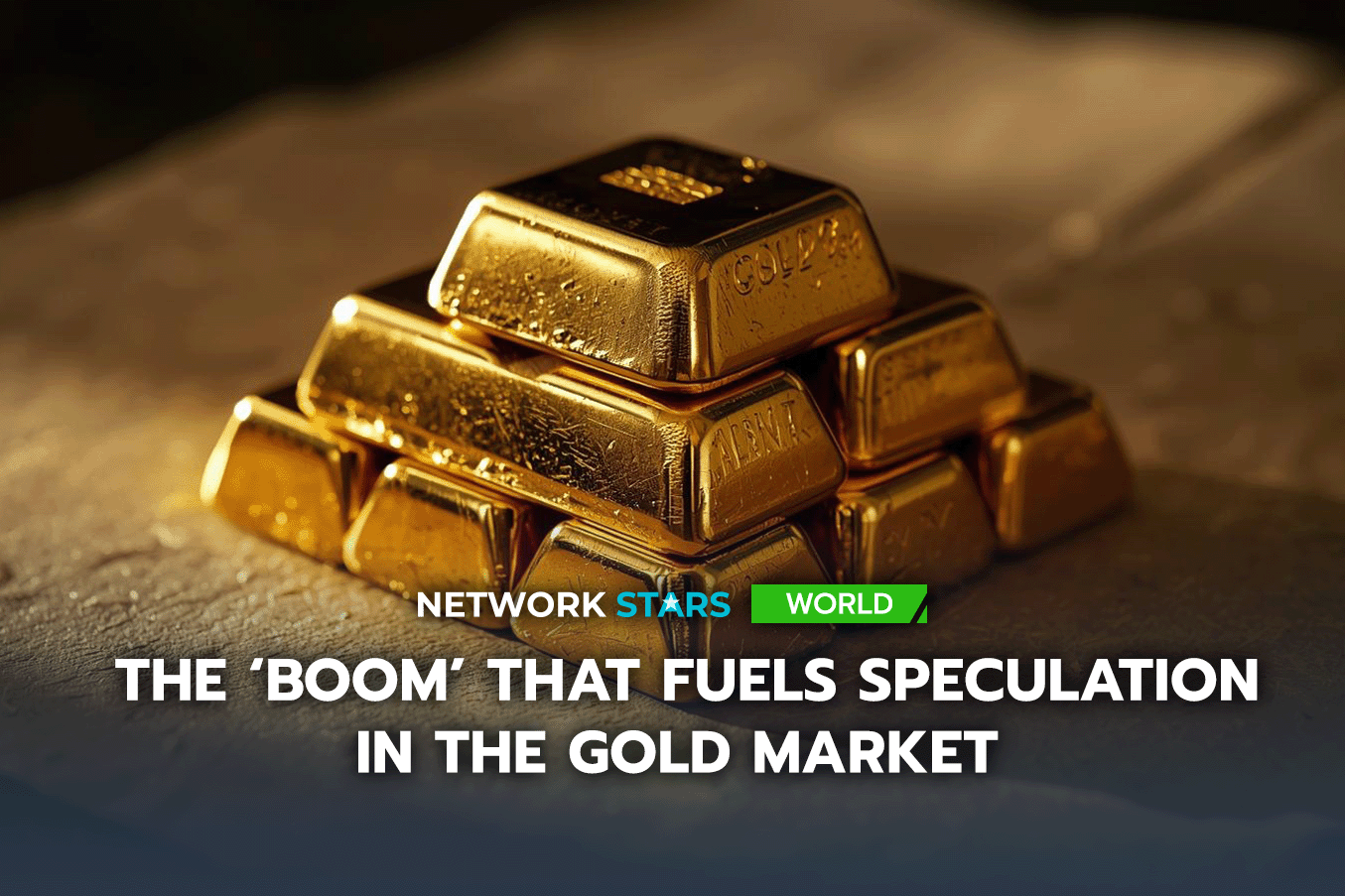
The price of gold has skyrocketed in recent months, explains Nicky Shields, director of precious metals investment strategy at MKS PAMP Group, in conversation with DW.
‘It is an indicator of the loss of confidence in governments and institutions.’ The question, he adds, is whether a relatively small market such as gold funds can absorb the current flood of capital.
Based in Geneva, MKS PAMP Group is one of the key players in the global precious metals industry. It processes gold, silver and platinum into bullion, coins and products for the jewellery and industrial sectors, and offers investment options for institutional and private clients.
‘Paper gold’: the market’s star performer
According to the World Gold Council, gold ETFs (Exchange Traded Funds) – exchange-traded funds that track the price of gold – rose from $472 billion in September to $503 billion in October, an increase of six per cent. In October alone, they took in $8.2 billion, well above the annual average of $7.1 billion.
In the third quarter of 2025, between July and September, physically backed gold ETFs recorded record inflows of $26 billion. North American investors led the movement, with $16.1 billion, while European funds also bought heavily and had their second-best quarter ever, with $8.2 billion.
Gold ETFs track the price of the metal without investors having to purchase and store bullion. Many hold physical gold in vaults, earning them the nickname ‘paper gold’.
Unlike equity funds, gold ETFs contain only one component – gold – and therefore do not diversify risk. They are not permitted in Germany, although they are in most European countries.
However, gold ETCs (Exchange Traded Commodities) are authorised. These are listed securities that replicate the performance of commodities such as gold.
The ‘gold rush’ continues
For Martin Siegert, an analyst at Baden-Württemberg Regional Bank, the upward trend will continue. ‘Many arguments in favour of gold remain fully valid,’ he wrote at the end of November on the bank’s platform. ‘Flows into gold ETCs should remain strong.’
Among these factors, he mentions expectations of lower interest rates in the United States, doubts about the future independence of the Federal Reserve, concerns about the strength of the dollar, and the possibility that US trade policy could cause further turbulence in 2026.
The Bank even raised its forecast: it estimates that gold could reach $4,600 by the end of 2026.
An ‘antifragile asset’
In October, gold reached a historic high of over $4,350 per troy ounce – an internationally standardised measure. Since then, it has stabilised at around $4,115 (as of 25 November).
In September, investment bank Morgan Stanley recommended that its clients modify the classic portfolio structure—60% equities and 40% bonds—to incorporate at least 20% in gold-linked products.
Mike Wilson, chief investment officer, told Reuters that gold is the ultimate ‘anti-fragile asset’, capable of offering protection in times of uncertainty. The 60/20/20 model would, according to him, be a ‘robust shield against inflation’.
The Financial Times described the phenomenon as ‘gold-plated FOMO’ (‘fear of missing out’): ‘Gold’s biggest bull run since the 1970s is being fuelled by investors’ fear of missing out on gains and concerns about rising inflation.’
Cryptocurrencies also want their share
The boom is not only coming from ETFs. According to Reuters, the American company Tether is also influencing the market.
Based in El Salvador, Tether is now the world’s largest digital asset company and issues the stablecoin USDT, a stable crypto asset that normally maintains a parity close to 1 dollar. On its platform, it promotes investments linked to goldcoins, digital currencies backed by gold.
The company has become the largest single owner of bullion outside central banks and holds reserves comparable to those of countries such as South Korea, Hungary and Greece.
For the MKS expert, the situation shows that even gold – traditionally a safe haven – is becoming an object of speculation.
‘Over the past two months, a real bubble has formed in the financial markets, not only in gold and silver, but also in US equities and the artificial intelligence sector,’ says Shields.
There are several causes for this ‘overheating’. ‘The Fed is lowering rates, even though we are not in recession. That injects more liquidity into a system that may not need it,’ he explains. ‘That’s why we’re seeing inflated valuations in AI-related assets, US equities and a growing bubble in gold and silver.’
Source: Yahoo!noticias
